

Civic anger, digital mobilization, and elite adaptation are reshaping the meaning of democratic accountability in Kenya.
Disclosure: This commentary draws on an earlier version published on Brookings and has been revised for StratGov Africa.
Kenya’s democracy is often assessed through the visible markers of political life: elections, institutions, constitutional order, and changes in leadership. But those measures tell only part of the story. The deeper test of democracy is whether power can still be questioned, checked, and compelled to respond when citizens feel ignored or excluded.
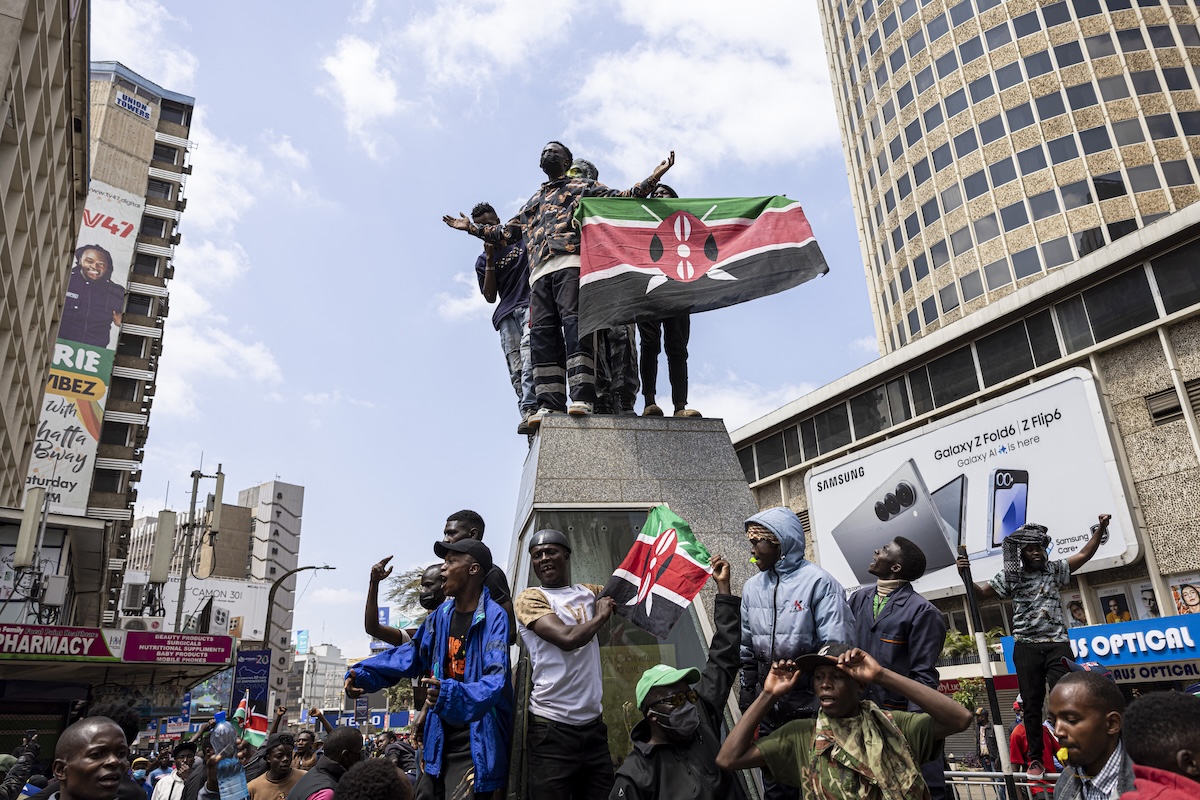
That is why the Gen Z protests of 2024 matter far beyond the Finance Bill that triggered them. They were not merely demonstrations against tax measures. They became a broader expression of frustration with exclusion, economic hardship, corruption, and the repeated failure of political elites to respond meaningfully to public concerns.
“Kenya’s democratic resilience has not come from institutional perfection, but from the fact that power has never gone completely uncontested.”
Democracy in Kenya Has Always Been Contested
Kenya’s democratic resilience is best understood not as a straight line of progress, but as the uneven result of three interacting forms of accountability.
The first is vertical accountability: elections, political competition, and the role of political parties in allowing citizens to reward or punish leaders. The second is horizontal accountability: the capacity of institutions such as Parliament, the judiciary, and oversight bodies to limit executive overreach. The third is diagonal accountability: the influence of civil society, religious organizations, the media, professional associations, and citizens acting outside formal state structures.
Since the return of multiparty politics in 1992, these forms of accountability have never functioned evenly or in harmony. Kenya has instead moved through cycles of contestation, regression, adaptation, and partial recovery. Power has often stretched institutional limits. Yet civic and institutional pressure has repeatedly forced renegotiation. That difficult interplay is what has helped the country absorb shocks and reopen democratic space, even in times of intense political pressure.
The Economic Context Behind the Protests
The Gen Z protests cannot be separated from the economic reality in which they emerged.
When President William Ruto took office in September 2022, he inherited a difficult economy marked by inflation, unemployment, and widening inequality. But rather than easing public pressure, the administration’s focus on aggressive revenue-raising measures deepened public resentment. For many young Kenyans already facing joblessness, insecurity, and rising living costs, the government’s policies did not feel like reform. They felt punitive.
This helped activate a stronger form of diagonal accountability. Young people mobilized not through the old party structures or ethnic patronage networks that have long shaped Kenyan politics, but through digital platforms such as X and TikTok. Their demands were clear: fiscal accountability, transparency, and meaningful public participation.
“For many young Kenyans, legitimacy is no longer secured by elite bargains. It must be earned through responsiveness and accountability.”
A New Form of Political Mobilization
What made the protests especially significant was not only their scale, but their character.
The June 2024 demonstrations were digitally coordinated, largely leaderless, issue-based, and strikingly cross-ethnic. Unlike many previous protest waves in Kenya, they were not anchored in opposition party hierarchies or ethnic blocs. They reflected a generational politics rooted in shared frustration over economic precarity, corruption, exclusion, and unresponsive governance.
This was politically important. It suggested that a new repertoire of civic action had emerged in Kenya—one less dependent on traditional gatekeepers and more grounded in collective moral claims expressed through digital public space.
That movement reached its most dramatic point on June 25, 2024, when protesters breached Parliament. The symbolism was powerful. It showed that a digitally connected generation could force the political establishment into a visible retreat. In the immediate aftermath, President Ruto shelved the Finance Bill and dissolved the cabinet. Those were major concessions, and they demonstrated that citizen pressure could still shape outcomes.
The Limits of Protest Victories
Yet the aftermath of the protests also exposed the limits of street-level wins.
Some of the dismissed cabinet secretaries later resurfaced in other senior appointments. At the same time, the regime moved to consolidate itself through new elite arrangements, including rapprochement with Raila Odinga and the incorporation of figures linked to both Odinga and former President Uhuru Kenyatta into government. While these moves may have reduced tensions among political elites, many activists saw them as a familiar recycling of elite bargains rather than a meaningful response to public demands.
This is one of the defining tensions in Kenya’s democracy: popular mobilization can force immediate concessions, but it does not automatically produce deeper reform. The executive can absorb pressure, reshuffle power, and rebuild elite coalitions while leaving the underlying causes of unrest intact.
“Popular mobilization can force short-term concessions, but the executive still retains powerful tools to reconfigure itself and survive.”
Why Elite Pacts Are Losing Their Force
For decades, Kenyan politics has often relied on elite accommodation to restore calm. These settlements can reduce conflict at the top, but they do not necessarily satisfy deeper public demands for justice, accountability, and inclusion.
What the Gen Z protests revealed is that this formula may be losing its power, especially among younger citizens. A digitally connected generation with weaker attachment to older political loyalties is less willing to accept elite pacts as a substitute for reform. That helps explain why public anger did not simply dissolve after the Finance Bill was withdrawn or the cabinet was dissolved.
There is a deeper political shift underway. More young Kenyans are contesting legitimacy not through traditional patronage or party allegiance, but through public scrutiny, digital mobilization, and issue-driven action. That does not mean formal politics has disappeared. It means it is increasingly being challenged by a new civic force that refuses to wait for elite permission.
The Risk to Civic Space
At the same time, this moment has also exposed threats to democratic resilience.
Reports of digital surveillance, intimidation, abductions, pressure on activists, and interference with judicial independence suggest a shrinking civic space. These are not minor developments. They strike directly at the accountability mechanisms that have historically helped prevent democratic closure in Kenya. If citizens are punished for dissent, or if institutions become less willing or able to constrain executive power, the country’s democratic resilience could weaken significantly.
The danger is not only authoritarian behavior in the dramatic sense. It is also the gradual normalization of coercion, fear, and political fatigue.
What This Moment Really Means
The forces that drove the protests have not disappeared. High living costs, unemployment, inequality, and deep distrust of political elites remain part of daily life for many Kenyans. These conditions will continue to create fertile ground for civic unrest and democratic pressure.
That is why the Gen Z protests should be read neither as a passing youth disturbance nor as a completed democratic breakthrough. They were both a warning and an opening.
They warned that the old methods of governing through symbolic concessions and elite accommodation are losing credibility. But they also opened space for a more substantive democratic possibility—one in which younger citizens, acting outside inherited political scripts, become a more permanent force in shaping public accountability.
The Future of Kenya’s Democracy
Kenya’s democracy is not dead. But neither is it secure.
It remains contested, adaptive, and under pressure. The Gen Z protests showed that citizen-driven accountability is alive and evolving. They also showed that resilience is not the same as democratic deepening. A system can survive repeated crises without becoming more just, more open, or more responsive.
The real question now is whether the energy of civic mobilization can be translated into more durable reform. If institutions adapt, Kenya may yet move toward a stronger and more participatory democracy. If they do not, the country risks repeating a familiar cycle in which public outrage disrupts power temporarily, only for elite arrangements to regroup and carry on.
That is what the protests revealed most clearly: the demand for accountability in Kenya is real, and it is growing. Whether the political system can truly answer it remains the defining democratic question of this moment.
About the Authors
Winnie Mitullah is a Research Professor at the Institute for Development Studies, University of Nairobi.
Oscar M. Otele is a Senior Lecturer in the Department of Political Science and Public Administration, University of Nairobi.
Karuti Kanyinga is a Research Professor at the Institute for Development Studies, University of Nairobi.
